

Beyond Accurate Translation: Why Clinical Trial Translation Services Need a Strategic Approach
June 4, 2026
How professional translation partners help pharmaceutical companies and CROs maintain document consistency, manage translation assets, and reduce costs.
Advances in artificial intelligence (AI) and machine translation have significantly improved the speed and efficiency of translation. Even complex medical documents can now be translated into a working draft in a relatively short time using AI-powered tools.
Does this mean pharmaceutical companies and contract research organizations (CROs) no longer need professional translation service providers?
A closer look at the practical demands of clinical trial translation suggests otherwise.
Translating clinical trial documentation involves much more than converting individual sentences from one language into another. It requires consistent terminology across numerous documents, effective management of revisions, adherence to sponsor-specific guidelines, and reliable quality control throughout the study lifecycle.
This is where professional translation companies play an essential role: managing the entire translation process systematically, rather than treating each document as an isolated assignment.
1. Accurate Medical Terminology Is Essential, but Consistency Across Documents Matters Just as Much
The foundation of clinical trial translation is the accurate communication of medical and regulatory information.
In clinical research, terms that appear similar may represent distinctly different concepts. Translators must therefore understand the context, applicable regulatory requirements, and study-specific definitions before selecting the appropriate terminology.
A common example is the distinction between adverse event (AE) and adverse reaction (AR).
An adverse event (AE) is an untoward medical occurrence in a participant who has received a medicinal product, regardless of whether it is considered related to that product.
An adverse reaction (AR), on the other hand, generally refers to a harmful and unintended response for which a causal relationship with the medicinal product is suspected. The precise definitions and criteria for assessing causality may vary depending on the applicable regulatory framework.
This distinction is particularly important when translating Korean clinical trial documents into English.
The Korean term 이상반응 is sometimes used broadly in source documents. However, translating every occurrence as adverse reaction may not accurately reflect the intended meaning.
Consider the following examples.
*Example A: An event regardless of causality
– Korean source: 시험약과의 인과관계에 관계없이 시험 기간 중 발생한 모든 이상반응을 기록한다.
– English translation: All adverse events occurring during the study shall be recorded, regardless of their causal relationship to the investigational product.
Here, adverse events is appropriate because the statement refers to medical occurrences that must be recorded regardless of their relationship to the investigational product.
*Example B: A reaction with suspected causality
– Korean source: 시험약과의 인과관계가 합리적으로 의심되는 이상반응은 별도로 평가한다.
– English translation: Adverse reactions for which a causal relationship to the investigational product is reasonably suspected shall be evaluated separately.
In this example, adverse reactions is appropriate because the statement specifically concerns reactions with a suspected causal relationship to the investigational product.
Although both Korean sentences use the term 이상반응, the appropriate English terminology differs according to the intended meaning.
A professional medical translation provider must recognize these distinctions and consult the study protocol, relevant regulatory guidance, and approved terminology when making translation decisions.
Where the source terminology conflicts with the definitions provided in the document, clarification should be sought from the client rather than introducing an unsupported interpretation.
Common Safety Terminology in Clinical Trials
| Abbreviation | Full Term | Definition |
|---|---|---|
| AE | Adverse Event | An untoward medical occurrence that does not necessarily have a causal relationship with the medicinal product. |
| AR / ADR | Adverse Reaction / Adverse Drug Reaction | A harmful and unintended response for which a causal relationship with the medicinal product is suspected, subject to the applicable regulatory definition. |
| SAE | Serious Adverse Event | An adverse event that meets seriousness criteria, such as death, a life-threatening event, hospitalization, or prolongation of existing hospitalization. |
| SAR / SADR | Serious Adverse Reaction / Serious Adverse Drug Reaction | An adverse reaction that also meets the applicable seriousness criteria. |
| SUSAR | Suspected Unexpected Serious Adverse Reaction | A suspected adverse reaction that is serious and unexpected based on the applicable reference safety information. |
| AESI | Adverse Event of Special Interest | An adverse event of particular scientific or medical concern that requires specific monitoring or evaluation. |
| TEAE | Treatment-Emergent Adverse Event | An adverse event that begins or worsens after treatment initiation, as defined by the study protocol. |
Note: Terminology and reporting requirements should always be interpreted in accordance with the applicable regulatory guidance and study-specific definitions.
Maintaining Consistency Across Clinical Trial Documents
Selecting the correct terminology is only the first step. Maintaining consistency across related documents is equally important.
A single clinical trial may generate numerous documents, including the study protocol, informed consent forms (ICFs), clinical study reports (CSRs), and safety-related documentation.
Although these documents serve different purposes and audiences, they describe the same study. Key medical concepts, study procedures, and approved terminology must therefore remain consistent wherever the context requires.
For example, progression-free survival (PFS) is commonly translated into Korean as 무진행 생존기간. Once this terminology has been approved for a particular study, it should be used consistently across related documents when referring to the same endpoint.
Inconsistent wording can create confusion and lead to unnecessary clarification during document comparison, review, and quality assurance.
It is also important to distinguish between related but different concepts. For instance, progression-free survival and progression-free survival rate are not interchangeable: the latter refers to the proportion of patients who remain progression-free at a specified time point.
Furthermore, pharmaceutical companies and CROs may have different preferences regarding terminology, abbreviations, and writing conventions.
Professional translation providers must therefore maintain client-approved terminology databases (term bases) and style guides, ensuring that the appropriate conventions are applied consistently across all relevant documents.
2. Translation Memory Is a Valuable Language Asset in Clinical Research
High-quality clinical trial translation goes beyond the accuracy of individual sentences. It should also communicate information consistently throughout the entire study.
One of the most important tools for achieving this is translation memory (TM).
A translation memory is a database that stores previously translated source and target text segments, allowing translators to retrieve and reuse approved translations when identical or similar content appears in subsequent documents.
Within a single clinical trial, descriptions of study procedures, endpoints, safety assessments, and other recurring information may appear repeatedly in protocols, informed consent forms, clinical study reports, and related materials.
Without a shared translation memory, the same sentence may be translated differently across documents.
Consider the following Korean source sentence:
Original Korean: 시험 요법을 중단한 대상자는 안전성 평가를 위한 추적관찰을 받게 됩니다.
This sentence could be translated in several ways.
Translation 1: Subjects who discontinue the study treatment will undergo follow-up for safety assessment.
Translation 2: Subjects who stop the study treatment will be followed up to assess their safety.
Translation 3: Participants who discontinue the study regimen will be followed for safety.
All three versions broadly convey the intended message. However, they differ in terminology and sentence structure.
For example, subjects and participants are used to refer to individuals enrolled in a clinical trial, while study treatment and study regimen may be used in different contexts. Similarly, undergo follow-up and be followed express the concept of follow-up using different constructions.
These choices are not necessarily interchangeable in every study. The approved terminology and precise meaning must always be considered.
Even when multiple translations are individually acceptable, using different versions of the same statement across a protocol, ICF, and CSR may reduce consistency and complicate cross-document review.
A professionally managed TM helps preserve previously approved wording and supports consistent translation across documents and revisions.
Benefits of a Well-Managed Translation Memory
Professional translation companies can establish and maintain study-specific or client-specific translation memories, providing several advantages:
- Consistent terminology and phrasing: Previously approved translations can be applied consistently across documents and versions.
- Reliable translation quality: Multiple linguists working on the same project can refer to shared translation resources.
- Improved efficiency: Reusing existing translations reduces unnecessary duplication of work.
- Long-term value: Translation data accumulated throughout a project can support subsequent documents and future assignments.
However, a TM match should never be accepted automatically without considering its context.
Even an identical sentence may require a different translation depending on the document, intended audience, or updated study requirements.
Professional linguistic review remains essential to ensure that reused translations are accurate and appropriate.
When properly maintained, a translation memory becomes more than a productivity tool. It serves as a valuable linguistic asset that supports consistency throughout the clinical trial lifecycle.
3. Long-Term Collaboration with a Translation Provider Can Reduce Costs
One of the most tangible benefits of working with the same professional translation company over time is the potential for reduced translation costs.
Clinical trial documents frequently contain repeated or similar content.
This is especially true for protocol amendments, updated informed consent forms, revised clinical study reports, and documents developed using standardized templates.
When previous translations are available in a well-maintained TM, substantial portions of new assignments may be eligible for reuse.
How Translation Memory Analysis Works
Computer-assisted translation (CAT) tools analyze source documents against existing translation memories and classify content into different match categories.
| Match Category | Description |
|---|---|
| New Words | Content with no corresponding match in the existing translation memory. |
| Fuzzy Matches | Content that is partially similar to previously translated segments. |
| 100% Matches | Content that exactly matches a source segment stored in the TM. |
| Repetitions | Identical segments that occur multiple times within the analyzed content. |
New content is generally charged at the standard translation rate.
For repeated or partially matching content, discounted rates may be available depending on how much of the existing translation can be reused and the level of review required.
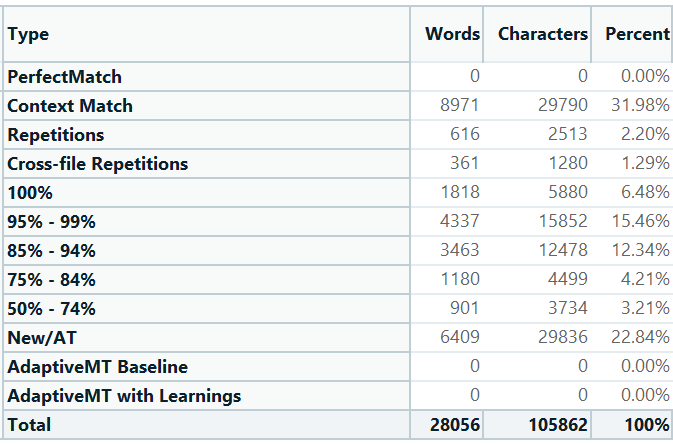
For example, consider a document containing 100,000 source words.
If a significant proportion of the content matches previously translated material, the cost and turnaround time may be substantially lower than those required to translate all 100,000 words from scratch.
The actual savings will depend on several factors, including:
- The similarity between the new documents and existing TM content
- The quality and reliability of previously approved translations
- The extent of editing and quality assurance required
- Client-specific requirements and the agreed pricing structure
A 100% match does not necessarily mean that no work is required. Existing translations may still need to be reviewed for context, accuracy, and consistency.
Nevertheless, continued collaboration with the same translation provider allows translation assets to accumulate over time.
As these resources grow, their value can be reflected in the cost efficiency and turnaround times of future projects.
4. Professional Translation Companies Reduce the Operational Burden on Pharmaceutical Companies and CROs
Translation requirements arise continuously throughout the clinical trial lifecycle.
Pharmaceutical companies and CROs may need to translate protocols, informed consent forms, investigator-facing materials, safety reports, regulatory correspondence, and many other documents at different stages of a study.
Managing these assignments entirely in-house requires significant time and resources.
Beyond selecting qualified linguists and coordinating deadlines, internal teams may need to manage terminology databases, translation memories, linguistic reviews, document revisions, and final deliverables.
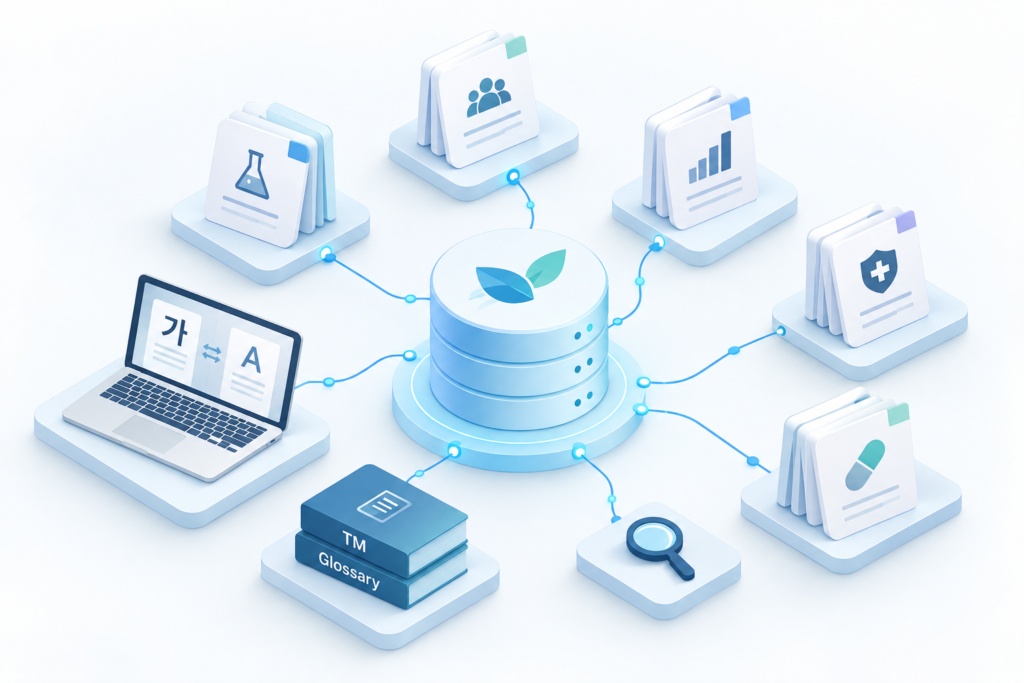
When several clinical trials are running simultaneously, coordinating translation activities can become an additional administrative burden for clinical operations and project management teams.
Working with a professional translation company provides a more streamlined approach.
Through a single point of contact, the translation provider can coordinate linguist assignments, maintain client-specific guidelines and translation assets, manage schedules, and oversee quality assurance.
This centralized approach reduces the need for pharmaceutical and CRO personnel to coordinate individual translation tasks.
As a result, internal teams can devote more time and attention to their core responsibilities, including clinical trial management and study operations.
5. The Role of Professional Translation Companies Is Evolving in the AI Era
AI-powered translation technology will continue to advance, and its use in professional translation workflows is likely to expand.
AI can already assist with drafting translations, processing repetitive content, and improving productivity.
However, producing a translation quickly is only one part of delivering reliable clinical trial documentation.
Accurate terminology, consistency across documents, compliance with client-specific guidelines, revision management, and final quality verification all require a coordinated approach to translation project management.
As a result, the value of a professional translation company increasingly extends beyond its ability to produce translated text.
It also lies in its ability to combine technology, specialized linguistic expertise, and structured quality management into a reliable end-to-end service.
AI can be a powerful tool for improving translation efficiency. However, its effective use in regulated clinical research requires appropriate professional oversight and quality control.
The objective is not simply to translate faster, but to deliver accurate, consistent, and reliable documentation throughout the study lifecycle.
Conclusion: Choosing a Translation Partner for the Entire Clinical Trial Lifecycle
Clinical trial translation is rarely a one-time task.
Translation needs continue to arise as studies progress, documents are revised, and new regulatory or operational requirements emerge.
When selecting a translation service provider, pharmaceutical companies and CROs should therefore consider more than the quality of individual translated documents.
Long-term terminology management, cross-document consistency, efficient handling of amendments, translation memory management, and cost efficiency are all important factors in building a successful partnership.
SORA Translations provides specialized translation services for clinical research, pharmaceutical, and medical documentation.
By systematically managing client requirements, approved terminology, and existing translation assets, we help our clients maintain consistent quality and streamline their translation workflows.
If your organization needs professional support with clinical trial document translation, contact SORA Translations to discuss your project requirements.