

Korean Life Sciences Localization: Adapting Global Content for the Korean Market
May 26, 2026
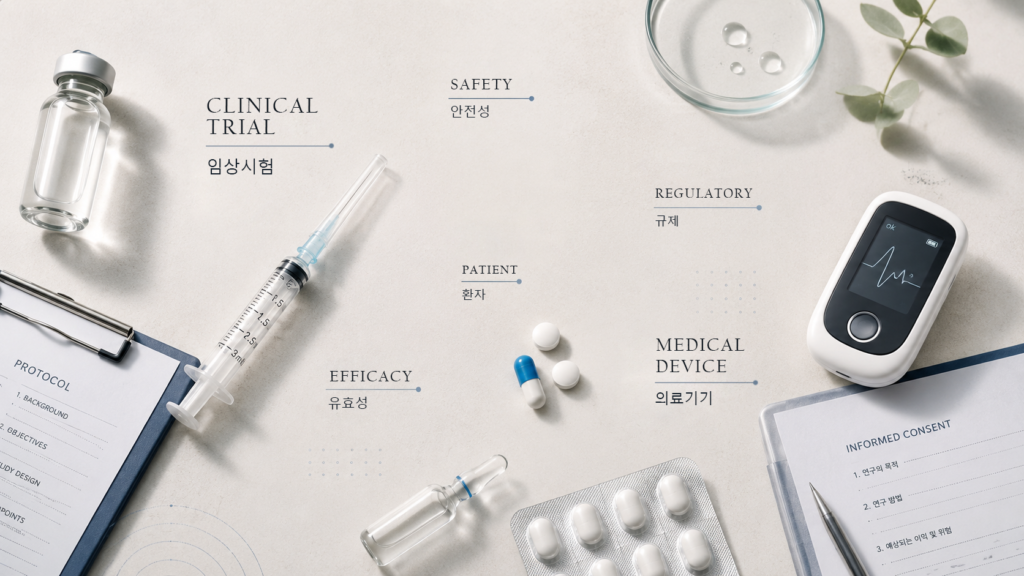
Expanding life sciences products and services into Korea involves more than translating English content into Korean. Clinical trial documents, regulatory materials, medical device documentation, safety information, and patient-facing content all need to communicate accurately within the Korean healthcare environment.
This is where localization becomes different from translation in its narrowest sense.
A linguistically accurate sentence may still feel unfamiliar in a Korean clinical document. A technically correct medical term may be inappropriate for a patient-facing material. Terminology that works perfectly in one document may create inconsistencies when used differently across a protocol, informed consent form, and clinical study report.
Effective Korean life sciences localization therefore requires more than bilingual fluency. It requires an understanding of terminology, document purpose, regulatory context, intended readers, and the way medical and clinical information is conventionally communicated in Korea.
1. Life Sciences Localization Goes Beyond Translation
In general content, a translator may have considerable flexibility in choosing how to express an idea naturally in another language.
Life sciences content is different.
Words and expressions often carry technical, regulatory, or operational significance. A seemingly minor wording choice may affect how a procedure, safety issue, or study requirement is understood.
At the same time, literal translation is not necessarily the safest solution.
English and Korean organize information differently. A translation that follows the English sentence structure too closely can sound unnatural, obscure relationships between concepts, or make instructions harder to understand. Conversely, excessive rewriting can introduce nuances that are not present in the source.
The translator must therefore preserve the meaning and level of precision of the source while expressing it in a form that is appropriate for Korean professional communication.
This balance is particularly important in documents such as:
- Clinical trial protocols and clinical study reports
- Informed consent forms
- Investigator-facing materials
- Pharmacovigilance and safety documentation
- Regulatory correspondence and submissions
- Medical device instructions and manuals
- Patient education and recruitment materials
Each document has its own purpose, audience, and linguistic conventions. Good localization begins by understanding those differences.
2. Terminology Must Fit the Korean Regulatory and Clinical Environment
Technical terminology is one of the most visible aspects of life sciences translation, but terminology management involves more than selecting medically correct words.
The question is often not whether a Korean term exists, but whether it is the term that Korean regulators, healthcare professionals, researchers, or industry stakeholders would normally expect to see in that context.
For regulatory and clinical documents, translators may need to consider terminology used by organizations and frameworks such as Korea’s Ministry of Food and Drug Safety (MFDS), Korean Good Clinical Practice requirements, institutional review boards, and relevant industry standards.
Even when two Korean expressions are technically synonymous, one may be more conventional in regulatory documentation while another is more common in clinical practice.
The same principle applies across document types. Terms related to adverse events, investigational products, study procedures, medical device functions, manufacturing, or quality systems should be translated consistently with their technical meaning and intended use.
Strong terminology management therefore depends on context, references, and consistency rather than dictionary equivalence alone.
3. The Target Reader Should Shape the Translation
One of the most important decisions in life sciences localization is identifying who will actually read the translated content.
Language written for an investigator is not necessarily appropriate for a patient.
Clinical protocols, statistical documents, and regulatory reports are generally written for professionals who are familiar with technical terminology. In these documents, precision and consistency with established terminology often take priority over simplification.
Patient-facing materials require a different approach.
An informed consent form, for example, may describe complex medical procedures, potential risks, study treatments, and a participant’s rights. The translation must remain medically accurate while being understandable to people who may have no medical background.
A medically precise translation can still fail if the patient cannot easily understand what it means.
However, simplification also has limits. Replacing a technical term with a more familiar expression may improve readability but unintentionally change the meaning, reduce precision, or create inconsistency with other study documents.
Effective patient-facing localization therefore requires a careful balance between:
medical accuracy, readability, consistency, and fidelity to the source.
The appropriate balance may be different for an informed consent form, patient diary, questionnaire, recruitment material, or medication instruction.
This is why life sciences localization should always consider not only what the source says, but also who needs to understand it and for what purpose.
4. Consistency Must Be Managed Across the Entire Documentation Set
Life sciences projects rarely consist of a single document.
A clinical study alone can generate protocols, amendments, informed consent forms, investigator materials, statistical analysis plans, safety communications, case report documentation, and clinical study reports.
These materials may be translated at different stages over months or even years.
Without systematic terminology management, small differences can gradually accumulate.
A concept may be translated one way in the protocol, another way in the informed consent form, and a third way in the final report. Each translation may appear acceptable in isolation, but together they can create unnecessary ambiguity.
This is especially important for:
- Study-specific terminology
- Product and device names
- Medical conditions and procedures
- Endpoint terminology
- Adverse event terminology
- Roles and responsibilities
- Repeated instructions
- Abbreviations and defined terms
Translation memories, approved glossaries, previous project files, and client references are valuable tools, but they do not replace linguistic judgment.
Previous translations may contain outdated terminology, project-specific choices, or expressions that are unsuitable for a new context. Translators need to maintain consistency while recognizing when consistency should not be applied mechanically.
In complex life sciences projects, quality is therefore not only a matter of producing an accurate document. It is also about maintaining a coherent language system across the entire project.
5. Linguistic Review Is Only One Part of Quality Assurance
A translation can read perfectly and still contain a serious error.
A dosage may be incorrect. A decimal point may be missing. A product name may have been altered. A table row may be misaligned. A cross-reference may point to the wrong section.
This is why quality assurance in life sciences translation needs to go beyond grammar and style.
Depending on the project, QA may include verification of:
- Numbers, dosages, and units
- Drug and product names
- Dates and time points
- Abbreviations and defined terms
- Terminology consistency
- Tables and figures
- Headers and footers
- Cross-references
- Tags and formatting
- Completeness of translated content
File preparation can introduce additional risks.
Source files may originate from scanned PDFs, OCR output, exported regulatory documents, or complex formatted files. Text may be segmented incorrectly, images may be mistaken for text, or formatting tags may appear in unexpected locations.
Some apparent translation problems therefore originate before translation even begins.
An experienced localization workflow looks at the entire document, not just isolated source and target segments. Reviewing the final target file against the source can reveal issues that are difficult to detect in a translation environment alone.
6. Three Lessons from Korean Life Sciences Localization
After working with clinical, medical, pharmaceutical, and medical device content, several principles consistently prove valuable.
Context matters more than literal equivalence.
A translation can be linguistically correct and still be inappropriate for a Korean clinical or regulatory document. Understanding how the content will be used is often essential to choosing the right expression.
Consistency should be intentional, not mechanical.
Terminology consistency is critical, particularly in long-term projects. But previous translations and translation memories should serve as references rather than unquestionable rules. Context must always come first.
The reader matters as much as the terminology.
The same medical concept may need to be communicated differently to a regulator, investigator, healthcare professional, or patient. Good localization preserves the scientific meaning while adapting the way that meaning is communicated.
Bringing Global Life Sciences Content to Korea
Successful Korean life sciences localization is not simply a process of replacing English words with Korean equivalents.
It is the process of transferring complex scientific, clinical, and regulatory information into another professional environment while preserving its meaning, purpose, and usability.
For global pharmaceutical companies, CROs, medical device manufacturers, and other life sciences organizations, the quality of Korean content can influence how effectively information is reviewed, understood, and used by local stakeholders.
At SORA Translations, we specialize in English-Korean localization for clinical, medical, pharmaceutical, and medical device content. Our approach combines linguistic accuracy with terminology management, contextual review, cross-document consistency, and thorough quality assurance.
Our goal is not simply to produce Korean text that mirrors the source.
It is to produce Korean content that is accurate, natural, consistent, and appropriate for the environment in which it will actually be used.
Planning to bring your life sciences content to Korea? Contact SORA Translations to discuss how your materials can be effectively adapted for Korean stakeholders.