

4 Common Mistakes in Pharmaceutical Translation and How to Avoid Them
November 5, 2026
Pharmaceutical translation is a highly specialized discipline. From drug development and clinical trials to regulatory submissions, manufacturing, quality control, and post-marketing safety monitoring, pharmaceutical documents require more than linguistic accuracy. Translators must verify official product names, use standardized medical terminology, and understand the conventions of regulatory and scientific documentation.
Even a translation that reads naturally can introduce inconsistencies when a term has an established regulatory or technical equivalent. Below are four common pitfalls in pharmaceutical translation and practical ways to avoid them.
1. Verify Drug Names Against Official Regulatory Sources
A pharmaceutical product may be marketed under different brand names in different countries. A name used in a general database may also differ in capitalization or include a dosage-form abbreviation. Translators should therefore identify the official name used in the relevant market and document context rather than relying on a single search result.
For Korean regulatory documentation, the Ministry of Food and Drug Safety (MFDS) Nedrug database is an important reference. Manufacturer websites and official product information can provide further confirmation.
Example: Moderna’s RSV vaccine
Consider Moderna’s RSV vaccine, which was approved in South Korea in 2025. The Korea Pharmaceutical Information Center lists its English product name as “M-Resvia PFS.” However, this is an incorrect rendering of the brand name: Moderna’s official website uses “mRESVIA”, and the Korean Ministry of Food and Drug Safety (MFDS) also identifies the product as “mRESVIA.” The discrepancy is not merely a matter of capitalization or an acceptable naming variation. It illustrates how an inaccurate English product name can appear even in a specialized pharmaceutical information database. Translators should therefore cross-check drug names against the manufacturer’s official materials and the relevant regulatory authority rather than treating any single secondary database as definitive.
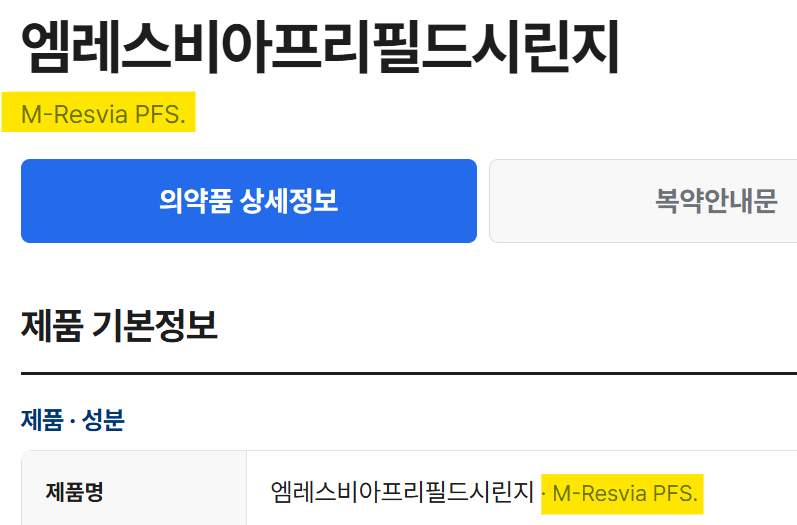

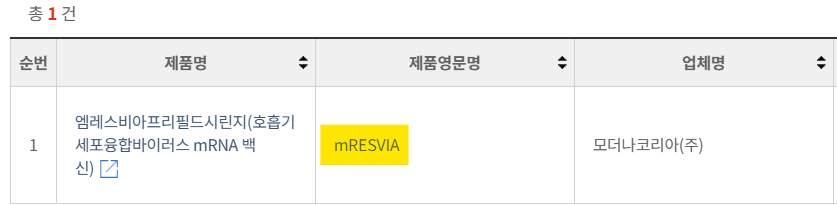
For products that have not yet been approved in the target market, check the manufacturer’s official materials, clinical trial records, and applicable foreign regulatory sources. Consistent naming is particularly important across protocols, informed consent forms, investigator brochures, and regulatory submissions.
2. Use MedDRA Terminology for Adverse Events and Adverse Drug Reactions
Safety documentation frequently requires terminology drawn from the Medical Dictionary for Regulatory Activities (MedDRA). MedDRA provides standardized terms for adverse events, medical history, indications, and other regulatory concepts. Free-form translations may sound acceptable but fail to match the terminology required for coding or reporting.
MedDRA is organized into five hierarchical levels: System Organ Class (SOC), High Level Group Term (HLGT), High Level Term (HLT), Preferred Term (PT), and Lowest Level Term (LLT).
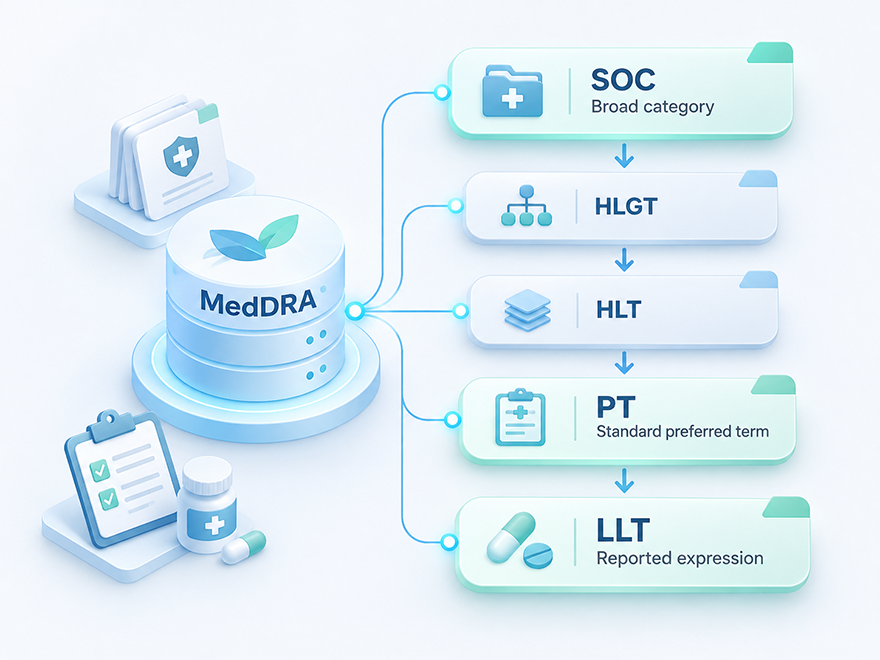
For example, the SOC term “Immune system disorders” should not be expanded to “Various immune system disorders” when the text refers to that exact MedDRA category. Similarly, “Psychosis postoperative” is a MedDRA-style standardized term; a more natural-sounding alternative such as “Postsurgical psychosis” may not be suitable when the task requires an exact coded term.
Examples of terminology that require verification
| Korean source | Possible free-form translation | Standardized MedDRA term |
|---|---|---|
| 외과적 및 내과적 시술 | Surgical and internal medicine procedures | Surgical and medical procedures |
| 상세 불명의 난청 | Unspecified hearing impairment | Unspecified deafness |
| 기억 장애 | Memory dysfunction | Memory disturbance |
| 기억 이상 | Memory defects | Memory impaired |
Note: These examples illustrate why term-level verification matters. Exact Korean-to-English equivalence, the appropriate MedDRA level, and the current release must be checked in the licensed terminology before using a term for safety coding. Narrative prose does not always require replacement with a MedDRA Preferred Term.
A robust pharmaceutical translation workflow distinguishes between ordinary medical descriptions and fields requiring exact controlled terminology, then applies the correct MedDRA release and client-specific coding instructions.
3. Confirm Official English Names of Hospitals and Medical Professionals
Clinical trial documents frequently identify institutions, departments, investigators, and ethics committees. Translating these names literally can produce a plausible but unofficial English name, making cross-document reconciliation more difficult.
For institutional review board (IRB) correspondence, approval letters, clinical trial agreements, and investigator records, check the hospital’s official English-language website. Physician profile pages may confirm the spelling of a medical professional’s name, department, and specialty. PubMed author records can provide additional clues, but they should be cross-checked because romanization and affiliations can vary.

A consistent reference list for institutions and investigators can prevent discrepancies across a clinical study’s protocol, informed consent forms, IRB submissions, and subsequent amendments.
4. Check Test Names and Methods Against Official Pharmacopoeias
Certificates of analysis (CoAs), specifications, analytical methods, and quality control documents frequently refer to compendial tests. A literal translation may describe the test correctly while failing to reproduce the official title of the referenced procedure.
When a document cites a recognized pharmacopoeial method, consult the relevant edition of the Korean Pharmacopoeia (KP), United States Pharmacopeia–National Formulary (USP–NF), or European Pharmacopoeia (Ph. Eur.).
| Test or method | General wording | USP general chapter title |
|---|---|---|
| Dissolution testing | Dissolution Test | Dissolution <711> |
| Sterility testing | Sterility Test | Sterility Tests <71> |
| Uniformity of dosage units | Dosage Unit Uniformity Test | Uniformity of Dosage Units <905> |
| Chromatography | Chromatographic Analysis | Chromatography <621> |
The general wording in the middle column is not necessarily incorrect in descriptive prose. However, when a specific USP chapter is cited, its official title and chapter number should be reproduced accurately. Always check the applicable pharmacopoeial edition and the client’s regulatory context.
Accurate Pharmaceutical Translation Starts with Reliable Source Verification
High-quality pharmaceutical translation is not simply a matter of fluent writing. It depends on careful source verification, consistent terminology, knowledge of the relevant regulatory framework, and systematic quality assurance. These practices reduce ambiguity and help teams maintain consistency across large, interconnected document sets.
At SORA Translations, we provide specialized translation services for pharmaceutical, clinical trial, and medical documentation. Our approach emphasizes terminology verification using authoritative sources, consistent application of client-specific requirements, and systematic management of existing translation assets.
By combining pharmaceutical and medical subject-matter expertise with structured quality control processes, we strive to deliver accurate, consistent, and reliable translations that support our clients’ regulatory and clinical documentation needs.
Looking for a reliable partner for pharmaceutical or clinical trial translation? Visit SORA Translations to learn more about our services or contact us to discuss your translation requirements.